Saltwater Pool Closing Kit
A salt water pool closing kit is a shock and a winter algaecide, pre-measured for a stated number of gallons, the same as any pool’s. Nothing in it is salt-specific. The salt steps are pulling the cell, filling the gap and not adding salt.
What’s in the kit, and whether to buy one
Buy a kit only if you don’t already own shock and algaecide. Size it at or just above your volume (the pool volume calculator works it out).
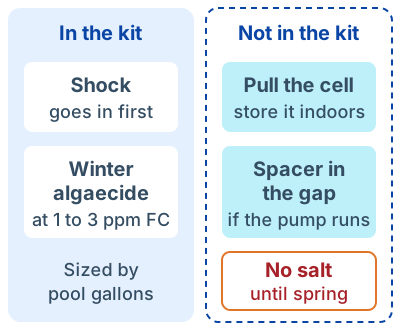
Check the algaecide label: Orenda’s winterization program says: “Avoid any metal-based products such as copper-based algaecides.” Shock doses are on salt water pool shock; the year-round shelf is on salt water pool chemicals. What a saltwater pool algaecide can and can’t do is covered separately.
The salt steps no kit includes
The cell has to come out before the first freeze. Hayward’s AquaRite manual says the cell and flow switch “will be damaged by freezing water,” and Pentair’s IntelliChlor guide says to “Remove the cell, clean and store it.”
Clean, then store
No metal
Hose first; scrape only with plastic or wood. Acid only for heavy scale: how to clean a salt cell.
Fill the gap
Spacer cell
Needed if the pump runs with the cell out. Pentair's dummy cell, P/N 520588, is sold for new-pool start-up.
Leave the control box. Hayward says the AquaRite’s electronic control “is capable of withstanding any winter weather and should not be removed.”
The cell has likely been idle for weeks anyway: the AquaRite stops below 50°F, the IntelliChlor below 52°F. See what temperature a salt cell stops working.
Close in this order
Balance the water first, to the AquaRite manual’s ranges.
pH
7.2 to 7.8
Alkalinity
80 to 120 ppm
Calcium
200 to 400 ppm
Then follow Hayward’s closing steps in this order.
- Shock. Use the kit's shock at the label dose.
- Wait, then add algaecide. Hayward says to "Never add shock and algaecide to the pool at the same time." Add it once free chlorine is back to 1 to 3 ppm.
- Lower the water. Hayward gives 12 to 18 inches below the skimmer for a mesh cover and 3 to 6 inches below the tile for a solid floating cover. Some covers need no drop.
- Drain the equipment. Hayward's manual says to "drain all water from the pump, filter, and supply and return lines before any freezing conditions occur." Blowing out and plugging the lines is on how to winterize a salt water pool.
- Pull the cell, then cover. Spacer in if the pump will run.
This replaces weekly salt water pool maintenance until spring. In a mild climate, read do salt water pools freeze before closing at all.
Don’t add salt before closing
A low fall reading is no reason to add salt. Pentair says the IntelliChlor returns to normal, “including accurate salinity report,” only above 52°F. Hayward adds that “Salt is not lost due to evaporation”; it leaves mainly with splashed, backwashed or drained water.
Test, don’t trust the panel. Check salt with a real test (salt levels covers which), size any shortfall on the pool salt calculator, and save the top up for spring: salt water pool start up kit.
Frequently asked questions
Is there a special closing kit for salt water pools?
No. Salt pools close with the same shock and algaecide as chlorine pools. Only the cell differs, and no kit covers it.
Do I need to remove the salt cell for winter?
Yes, wherever it can freeze. Both Hayward and Pentair warn that freezing water damages the cell.
Can I add the shock and algaecide together?
No. Hayward says to let free chlorine fall back to 1 to 3 ppm after the shock, then add the algaecide.
Should I add salt before I close the pool?
No. The panel can misread in cold water, and salt doesn’t evaporate. Recheck with a test in spring.
Does the salt in the water keep it from freezing?
No. At 3,200 ppm it freezes about a third of a degree below fresh water: see what temperature saltwater freezes. More guides are on the salt cell hub.
Last updated