Salt Water Pool Shock: What to Use and How Much
To shock a salt water pool, pour in liquid chlorine until free chlorine reaches 40% of your CYA, which is 28 ppm at CYA 70. The boost button can’t get there. A 20,000 gallon pool at CYA 70 and 3 ppm needs about 4.2 gallons of 12% liquid chlorine.
Why the boost button is not shock
A boost adds single digits of ppm. Hayward’s AquaRite manual runs super chlorinate for 24 hours, and its largest cell, the T-CELL-15, makes 1.5 pounds of chlorine in that time.
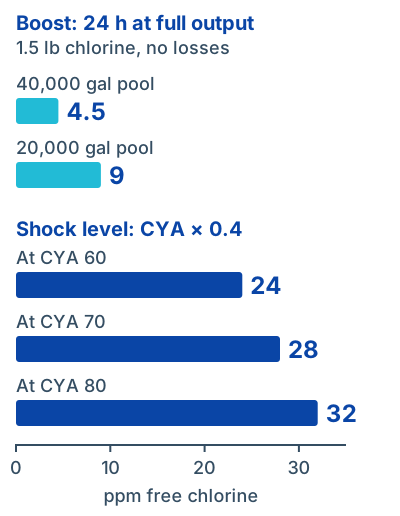
Hayward lists super chlorinate for a heavy bather load, heavy rain or cloudy water. For algae or a free chlorine reading near zero, use a jug.
Best shock for a salt pool
Liquid chlorine is the best shock for a salt pool: it adds no stabilizer or calcium. Cal-hypo is second.
Cal-hypo, about 67%
1 lb = 8 ppm
Per 10,000 gallons (Indiana: 2 oz per ppm). It also raises calcium hardness.
Skip cal-hypo with hard water: the first place to form scale is usually in the salt cell or the heater. See salt water pool chemicals and which shock contains CYA.
Non-chlorine shock won’t work. It has no chlorine, so it can’t reach shock level or kill algae. See non chlorinated shock for pools.
How much shock a salt pool needs
Shock level is CYA × 0.4, the rule on our CYA chlorine chart. At Hayward’s 60 to 80 ppm stabilizer, that’s 24 to 32 ppm. Dose for the rise from your current reading:
Fl oz of 12% = 10.7 × (gallons ÷ 10,000) × ppm rise
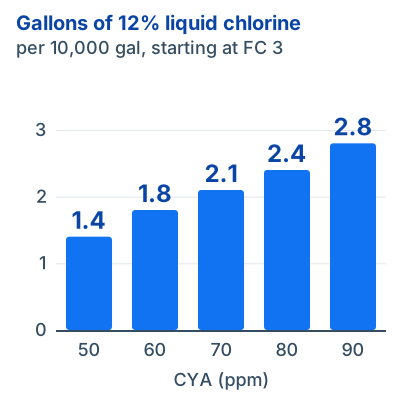
Example. 18,000 gallons, CYA 80, FC 2: a 30 ppm rise. 10.7 × 1.8 × 30 = 578 fl oz, about 4.5 gallons of 12%, or 6.75 lb of 67% cal-hypo.
Gallons of 12% from FC 3, 15,000 to 30,000 gallon pools
| Gallons | CYA 60 | 70 | 80 |
|---|---|---|---|
| 15,000 | 2.6 | 3.1 | 3.6 |
| 20,000 | 3.5 | 4.2 | 4.8 |
| 25,000 | 4.4 | 5.2 | 6.1 |
| 30,000 | 5.3 | 6.3 | 7.3 |
Use real gallons from the pool volume calculator. A 10% jug takes 12.8 fl oz per ppm (10.7 × 12 ÷ 10); bleach is on how much bleach to shock a pool. CYA over 80? See salt water pool stabilizer.
How to shock a salt water pool
Shock in the evening with the pump on. Orenda says sunlight can wipe out chlorine by 75 to 90% in two hours.
- Test. Free chlorine, CYA and pH; get pH into Hayward's 7.2 to 7.8.
- Wait for evening. HTH advises evening dosing with the pump running.
- Add it. Pour liquid in front of the returns. Broadcast cal-hypo and brush settled granules; a 52% cal-hypo label warns prolonged contact may stain or bleach surfaces.
- Don't boost. Leave the cell at its normal setting or lower.
- Retest at dawn. If free chlorine fell far below shock level, dose back up that evening.
Swim at 1 to 4 ppm, usually 8 to 24 hours later per HTH. When to shock at all is on how often to shock a salt water pool.
What shock will not fix
Shock fixes the water, not why it ran out of chlorine.
Frequently asked questions
Can you use regular shock in a salt water pool?
Yes, if it’s unstabilized. HTH lists its cal-hypo shock as saltwater compatible.
Can I shock a salt water pool with bleach?
Yes. Bleach is sodium hypochlorite like pool liquid chlorine, usually weaker, so scale the dose to the percent on the jug.
Should I turn off my salt cell when I shock?
No. Leave it at its normal setting and skip boost; a full day of boost adds 9 ppm at most in 20,000 gallons, so the jug does the shocking.
How do I stop needing to shock?
Keep free chlorine at or above 5% of CYA every day, 4 ppm at CYA 80. See salt water pool maintenance, and algae in a salt water pool if green comes back.
Last updated