Chlorine Tablets Without CYA: Chart by Pool Size
Chlorine tablets without CYA are calcium hypochlorite (cal hypo) tablets, such as HTH Brilliance, which add no stabilizer. Standard 3 inch tabs are trichlor, and more than half their weight is cyanuric acid that stays in the water. A salt pool rarely needs either, because the cell makes chlorine without adding CYA.
How much CYA trichlor tablets add
Each pound of trichlor tablets adds about 6.6 ppm CYA to 10,000 gallons (Orenda’s table says 6.68). Orenda: “trichlor is only 45.8% chlorine (by weight). The majority of it is cyanuric acid.” By molecular weight (129.07 ÷ 232.4) it’s 55%; HTH puts its tabs at “approximately 57%.”
CYA added (ppm) = pounds of tablets × 66,000 ÷ gallons
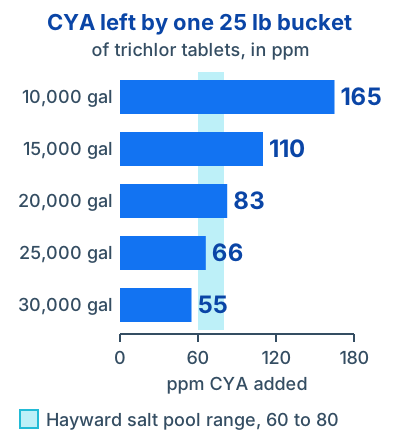
CYA added (ppm) per 1, 5 and 10 lb of tablets
| Gallons | 1 lb | 5 lb | 10 lb |
|---|---|---|---|
| 10,000 | 6.6 | 33 | 66 |
| 15,000 | 4.4 | 22 | 44 |
| 20,000 | 3.3 | 16.5 | 33 |
| 25,000 | 2.6 | 13.2 | 26.4 |
| 30,000 | 2.2 | 11 | 22 |
Free chlorine needs climb with CYA: see the CYA chlorine chart.
Chlorine without cyanuric acid
Cal hypo, liquid chlorine and your salt cell all add none. Per Orenda, “All the CYA in a swimming pool was either added directly (granular or liquid CYA products), or as a byproduct of stabilized chlorine (sodium dichlor or trichlor).”
Cal hypo tablets
Tablet
Calcium hypochlorite. Adds calcium with every dose.
Salt cell
Built in
Makes chlorine from the salt already in the water.
Dichlor shock carries CYA too: see does pool shock have cyanuric acid.
Using cal hypo tablets in a salt pool
HTH calls its cal hypo tablets “compatible with vinyl liner, plaster, fiberglass, and saltwater pools,” but they need a feeder of their own.
Never share a feeder with trichlor. HTH: “Never use in equipment that has previously held trichlor tablets.” Mixing them “may cause a dangerous chemical reaction,” per its Brilliance page.
- Check CYA. HTH says to use them "when stabilizer is already at or above 50 ppm."
- Use a clean feeder. HTH lists its Brilliance Floater or an empty skimmer basket.
- Dose. "Use one tablet per 10,000 gallons every week, or as needed to hold a 1-4 ppm chlorine residual."
- Watch pH and calcium. HTH says the tabs raise pH slightly, on top of the cell's own push. Calcium scale on the plates is what how to clean a salt cell deals with.
Why a salt pool rarely needs tablets
If you add tablets every week, the cell isn’t keeping up. Hayward’s AquaRite manual raises chlorine by output: “Raise desired output % to increase” or increase “pump filtration time.” Setting both is on optimal chlorine levels saltwater pool.
Cell stopped
Liquid chlorine
Use it while you test the salt cell and work through salt cell not producing chlorine.
Going away
More output
Raise output % and pump hours before you leave.
Getting CYA back down
Draining and refilling or reverse osmosis are the methods that work. Orenda: “the most economical way to reduce CYA is to drain and dilute,” and while CYA does oxidize, “it takes months and high chlorine levels.”
Example. Bringing CYA from 100 to 60 ppm means replacing 40% of the water (1 minus 60 ÷ 100), assuming the fill water has none. The steps are on reduce cyanuric acid in a swimming pool.
Where sources disagree on a target is on best range of CYA for a salt pool. Confirm the reading with the CYA pool test kit first. See also salt cells and water care.
Frequently asked questions
Does a salt cell add CYA?
No, but the pool still needs some stabilizer: Hayward asks for 60 to 80 ppm.
Can I put chlorine tablets in a salt water pool?
Yes, HTH lists its trichlor tabs as saltwater compatible, but every pound adds CYA.
How do I tell if a tablet has CYA?
Read the active ingredient. Trichloro-s-triazinetrione (trichlor) or dichlor means it contains the CYA sold alone as chlorine stabilizer for pool; calcium hypochlorite means none.
Do cal hypo tablets raise calcium hardness?
Yes, every dose adds calcium. Hayward’s range is 200 to 400 ppm, so test calcium hardness along with CYA.
Last updated