Baking Soda in a Salt Water Pool: How Much and When
Baking soda in a salt water pool raises total alkalinity and barely moves pH: add 1.5 lb per 10,000 gallons for each 10 ppm. It’s safe for the cell; Hayward’s AquaRite manual says “Add baking soda to increase” alkalinity to 80 to 120 ppm. If alkalinity keeps dropping, acid is the usual cause.
How much baking soda to add
Arm & Hammer’s rule of thumb is 1.5 lb per 10,000 gallons for about 10 ppm of alkalinity.
Baking soda (lb) = 1.5 × (gallons ÷ 10,000) × (ppm rise ÷ 10)
Example. A 15,000 gallon pool at 60 ppm needs 20 ppm to reach 80: 1.5 × 1.5 × 2 = 4.5 lb. Arm & Hammer suggests adding half to three quarters of that first, 2.25 to 3.4 lb, then retesting.
Check gallons with the pool volume calculator.
Dose table by pool size
| Gallons | +10 ppm | +20 ppm |
|---|---|---|
| 10,000 | 1.5 lb | 3 lb |
| 15,000 | 2.25 lb | 4.5 lb |
| 20,000 | 3 lb | 6 lb |
| 25,000 | 3.75 lb | 7.5 lb |
| 30,000 | 4.5 lb | 9 lb |
How to add it
Dissolve it first, then circulate at least six hours before retesting.
- Test alkalinity and pH. Fix alkalinity first, then recheck pH, the order Orenda uses.
- Pre-dissolve in a bucket. Orenda says undissolved bicarb "can cloud up the pool." Pour it around the edge, not into the skimmer.
- Run the pump six hours or more. Retest within 24 hours; add the rest only if needed.
Haze that outlasts a day of filtering has another cause: cloudy salt water pool.
Baking soda vs soda ash
Baking soda (sodium bicarbonate) raises alkalinity; soda ash (sodium carbonate) raises pH. Orenda says that without an acid feeder “you should never need soda ash.”
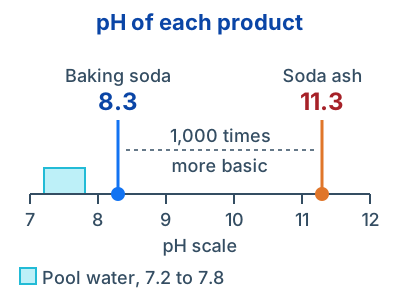
Salt pool pH climbs on its own, so low pH is rare: see how to raise pH in a salt water pool. High pH needs acid: how to lower pH in a salt water pool and muriatic acid for a salt water pool.
Why salt pool alkalinity keeps dropping
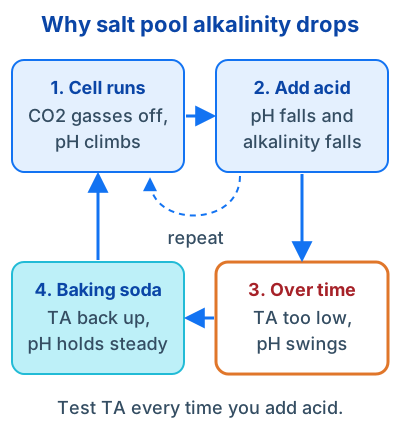
Acid takes it: “Using acid lowers both the pH and alkalinity in water,” says Orenda. Salt pools need acid often because hydrogen bubbling off the cell drives out CO2, which raises pH (more on pH of salt water).
Don’t overshoot
Aim low in the range: Orenda’s calcium flakes article says most flaking salt pools have a high LSI “because they have too much alkalinity in their water.”
Hayward
80 to 120 ppm
AquaRite manual range.
Orenda, cold water
80+ ppm
Keeps the LSI balanced.
Test alkalinity with pH as part of salt water pool maintenance. See also salt water pool chemicals, salt water pool shock, salt cells and water care and the pool salt calculator.
Frequently asked questions
Is baking soda safe for a salt water pool?
Yes, Hayward’s manual names it for raising alkalinity. The risk is overshooting, which drives scale.
Is alkalinity increaser the same as baking soda?
Yes, both are sodium bicarbonate; Maytronics lists it as its increaser’s active ingredient.
Will baking soda raise my pH?
Only slightly. Orenda says you can add a lot “while having only a minimal impact on the pH.”
What if I add too much baking soda?
Only acid brings it down, and pH drops too. Orenda says to lower alkalinity no more than 20 ppm per day; see how to reduce alkalinity in a salt water pool.
Last updated